Derivation: keys, rows, columns
Summary
One specification produces one dataset:
output_dataset = derive(input_datasets, spec)
yamaa first constructs the output rows and then derives columns onto those rows. Column derivation never changes the row count.
| Spec field | Question | Answer |
|---|---|---|
keys: |
What identifies a row? | The ordered columns whose combined values must be present and unique. |
rows: |
Which rows exist? | When present, row templates construct rows from retained input records or groups. |
columns: |
What does each row carry? | Each derivation produces exactly one value per constructed row, in declaration order. |
When rows is absent, the distinct key combinations in the default input
construct the output rows. When rows is present, its templates construct the
rows and keys validate their identity.
Keys identify rows
keys: is always required. It names output columns that together identify
one row:
domain: ADSL
keys: [STUDYID, USUBJID]   # one row per subject
domain: ADLB
keys: [STUDYID, USUBJID, PARAMCD, ADT, ASEQ]   # one row per analysis record
domain: ADAE
keys: [STUDYID, USUBJID, AESEQ]   # one row per event
Every completed row must have non-missing key values, and no two rows may have the same key combination.
Without rows: distinct keys construct the rows
Omit rows when the desired output has one row per distinct key combination
already represented by the input. The input need not be physically
one-to-one: several input records may contribute values to the same output
row.
schema_version: "1.0"
domain: ADSL
input:
  DM: source/dm.csv
output:
  path: adsl.csv
  columns: [STUDYID, USUBJID, AGE]
keys: [STUDYID, USUBJID]
columns:
  - name: STUDYID
    type: str
    label: Study Identifier
    derivation: DM.STUDYID
  - name: USUBJID
    type: str
    label: Unique Subject Identifier
    derivation: DM.USUBJID
  - name: AGE
    type: int
    label: Age
    derivation: DM.AGE
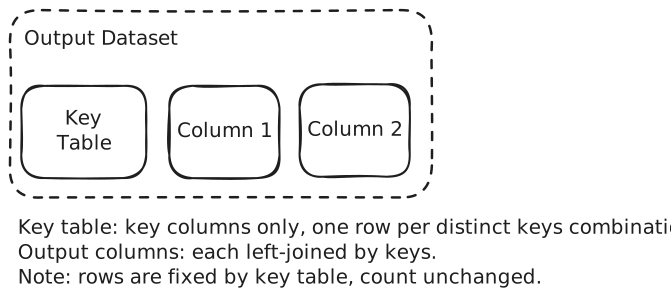
Read the diagram from left to right. The Key Table contains each distinct key combination once, in first-appearance order. Column 1 and Column 2 attach values to those fixed rows.
Each column derivation must resolve to exactly one value for a row. Repeated copies of the same present value still count as one value; competing present values fail instead of forcing yamaa to choose. A missing result remains the row's single missing value.
With rows: templates construct sections
Use rows when the specification must explicitly construct different kinds
of output rows. Each entry is a row template and builds one section.
Sections concatenate in specification order.
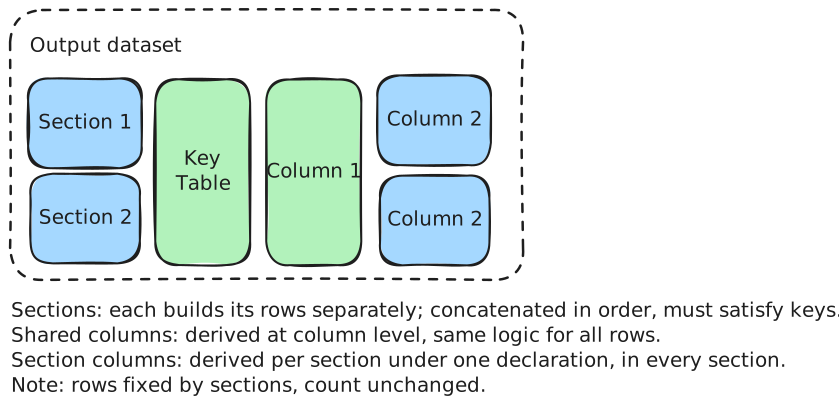
This partial fragment builds separate HEIGHT and WEIGHT sections from one input dataset:
input: {VS: source/vs.csv}

rows:
  - id: height
    filter: "VS.PARAMCD = 'HEIGHT'"
    derivations:
      PARAMCD: {literal: HEIGHT}
      AVAL: VS.AVAL

  - id: weight
    filter: "VS.PARAMCD = 'WEIGHT'"
    derivations:
      PARAMCD: {literal: WEIGHT}
      AVAL: VS.AVAL
The constructed rows must still satisfy keys: every key value must be
present and every key combination unique. Section order is construction
order; an optional output.order_by may independently reorder the finished
artifact.
Columns fill the constructed rows
Columns resolve in declaration order, so a later column may read an earlier
one. A column-level derivation is the column's default: every rows entry
inherits it, and a rows entry may name the column in its own derivations
to override the default for that entry's rows only. A column with no
column-level derivation must be derived in every rows entry; use
{literal: null} when its value is deliberately missing in one section.
One restriction: a column-level derivation that reads across rows -- a
lookup, an aggregate, a window, or a named intermediate -- is not row-local,
so pairing it with a rows entry's own derivation for the same column fails
validation instead of deriving the column twice.
More examples
- Derive age groups in ADSL: adam-adsl-age-group.
- Derive BMI in ADVS: adam-advs-bmi.